
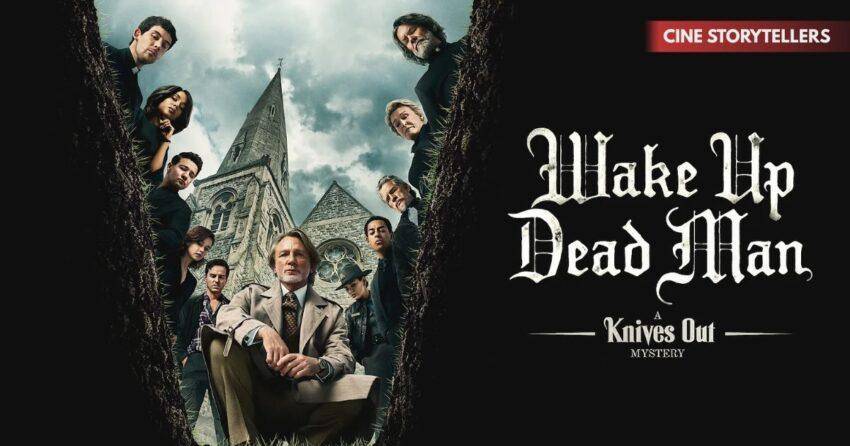
Wake Up Dead Man: A Knives Out Mystery delivers one of the most layered and emotionally complex endings in the franchise so far. What begins as a seemingly straightforward locked-room murder inside a troubled church slowly unravels into a story about power, faith, greed, and misplaced devotion. By the time Benoit Blanc reveals the truth, nearly every character has played a role—directly or indirectly—in the tragedy. This detailed explanation breaks down who really killed Monsignor Wicks, how the elaborate cover-up worked, and why the ending leaves viewers questioning whether justice was truly served.

The Murder That Starts Everything
The mystery begins with the shocking death of Monsignor Jefferson Wicks, a powerful yet controversial church leader. During a Good Friday service, Wicks collapses and is later found dead in a locked room, stabbed and apparently killed in plain sight.
At first glance, the crime appears almost impossible. No one saw anyone enter or leave. The room was locked. The congregation was present. It feels like a classic whodunit setup—but with a darker, more unsettling tone than previous entries in the franchise.
Naturally, suspicion falls quickly on Father Jud, the church’s newest priest. He has a violent past, a tense relationship with Wicks, and was physically close to him during the service. To the police, the case feels open-and-shut.
But Benoit Blanc knows better.
Why Father Jud Was the Perfect Red Herring
Father Jud is designed to look guilty. He’s an outsider, emotionally raw, and visibly uncomfortable within the rigid hierarchy of the church. His background as a former boxer makes him an easy target for suspicion, especially when paired with his public disagreements with Wicks.
However, Wake Up Dead Man makes a key point early on: obvious answers are usually wrong.
Jud’s role in the story is less about guilt and more about contrast. He represents sincerity in a system riddled with hypocrisy. While others hide behind appearances, Jud is painfully transparent. That transparency is exactly why Blanc keeps him close instead of treating him like a suspect.
The First Major Reveal: Wicks Wasn’t Killed Instantly
As the investigation progresses, Blanc uncovers a critical detail: Monsignor Wicks did not die from the stabbing alone.
Wicks had been drugged before the service. The sedative slowed his body down, making the stabbing appear sudden and mysterious while masking the true sequence of events. The locked-room illusion was carefully constructed, not accidental.
This revelation shifts the case from an impulsive act of violence to a meticulously planned execution.
Someone wanted this death to look miraculous, unexplainable—and above all, symbolic.
Martha Delacroix and the Secret Beneath the Church
The story truly pivots when attention turns to Martha Delacroix, the church’s long-time administrator. Quiet, efficient, and deeply devoted, Martha initially appears to be one of the least suspicious figures in the building.
In reality, she is the emotional and intellectual center of the entire conspiracy.
Martha reveals that Monsignor Wicks had discovered a family secret involving a priceless diamond hidden decades earlier by his grandfather, a former religious leader. The diamond was rumored to have been swallowed before death and entombed, effectively vanishing from history.
Wicks planned to recover the diamond and use its value to fund personal ambitions far removed from spiritual service.
To Martha, this wasn’t just corruption – it was betrayal.
Murder as a Twisted Act of Faith
Unlike villains in previous Knives Out films, Martha does not see herself as evil. She believes she is protecting something sacred.
In her mind, killing Wicks was an act of preservation. She convinced herself that removing him would save the church from exploitation and restore its moral authority.
This moral distortion is one of the film’s most chilling elements. Martha isn’t driven by greed or rage—she’s driven by belief. That makes her far more dangerous.
Her plan wasn’t just to kill Wicks. It was to transform his death into a miracle.
The Resurrection Scheme Explained
Martha’s plan goes far beyond murder.
She conspires with Dr. Nat Sharp, a trusted church member, to stage a resurrection. The idea is horrifying in its ambition: bury a living man in Wicks’s coffin so that he could later emerge, retrieve the diamond, and create the illusion of divine intervention.
That man is Samson, the church groundskeeper.
The hope was that this “miracle” would revive faith, attract followers, and secure the church’s future.
But human greed once again ruins everything.
How the Plan Completely Falls Apart
Dr. Nat Sharp betrays Martha almost immediately.
Instead of following the plan, he murders Samson to claim the diamond for himself. He then destroys the bodies to eliminate evidence, turning what was already a moral disaster into something far worse.
This betrayal shatters Martha’s illusion that she was in control. Her attempt to justify one death spirals into multiple killings, all driven by selfish ambition rather than faith.
By the time she realizes what Nat has done, it’s too late to undo the damage.
Martha’s Final Decision and Confession
In the film’s most emotionally devastating sequence, Martha confronts Nat. She poisons him with the same substance she intended to use on herself, killing him and ending the immediate threat.
But she doesn’t run.
Instead, weakened and remorseful, Martha confesses everything to Benoit Blanc and Father Jud. Her confession is not defensive. It’s exhaustive, honest, and filled with regret.
She dies shortly afterward, bringing the cycle of violence to a close—but not without consequences.
What Benoit Blanc Reveals and What He Doesn’t
One of the most fascinating aspects of the ending is Blanc’s restraint.
He explains the mechanics of the crime to authorities: the drugging, the staged stabbing, the false locked-room illusion. But he deliberately avoids publicizing certain details, including the full resurrection plot and the diamond’s ultimate fate.
This choice reflects Blanc’s evolving sense of justice. Solving the puzzle is not the same as serving truth. Sometimes, exposing everything only deepens harm.
In this case, Blanc allows the story to end quietly, without spectacle.
The Diamond’s Final Resting Place
The diamond does not disappear.
Instead, Father Jud hides it inside a newly constructed crucifix in the rebuilt church. The symbolism is intentional. Wealth that once fueled corruption is now sealed away, stripped of power and temptation.
Jud’s choice suggests a different kind of faith—one that prioritizes humility over dominance, healing over control.
It’s not a perfect ending, but it is a meaningful one.
The Bigger Themes Behind the Ending
Wake Up Dead Man is less interested in clever twists than in moral consequence.
The film explores how institutions can justify terrible acts in the name of righteousness. It asks whether belief excuses behavior and whether good intentions can ever justify irreversible harm.
Unlike previous films in the franchise, the ending doesn’t feel triumphant. It feels reflective. The truth comes out, but no one truly wins.
And that discomfort is intentional.
Also Read : Jennifer Connelly Turns 55: From Labyrinth Star to Oscar-Winning Hollywood Icon
How This Ending Compares to Other Knives Out Films
Where earlier entries leaned heavily on satire and social commentary, Wake Up Dead Man is more introspective.
There is no single villain reveling in their brilliance. Instead, there are people who convinced themselves they were doing the right thing—until everything collapsed.
The mystery isn’t just who killed whom. It’s how belief can become dangerous when left unchecked.
Why the Ending Lingers Long After the Credits
The final moments leave viewers with unresolved questions.
Did justice truly prevail?
Was hiding the diamond the right choice?
Could this tragedy have been prevented?
The film doesn’t answer these directly. It trusts the audience to sit with the ambiguity.
That trust is what elevates the ending beyond a typical whodunit.
Also Read : Hailee Steinfeld Is Pregnant – Actress and NFL Husband Josh Allen Expecting First Baby
FAQs
Who killed Monsignor Wicks in Wake Up Dead Man?
Martha Delacroix orchestrated his murder by drugging him before staging the fatal stabbing.
Was Father Jud responsible for any of the deaths?
No. Father Jud was falsely suspected but ultimately proven innocent.
What was the purpose of the resurrection scheme?
Martha believed staging a miracle would restore faith and protect the church’s future.
What happened to the diamond?
Father Jud hid it inside a crucifix, removing it from circulation and temptation.
Why didn’t Benoit Blanc reveal everything publicly?
Blanc chose discretion, believing full exposure would cause more harm than justice.
Join our WhatsApp channel for more updates and information about celebrities and entertainment.


I’m Atul Kumar, founder of Cine Storytellers and an entertainment creator with 5+ years of experience. I cover films, celebrities, music, and OTT content with a focus on accurate, ethical, and engaging storytelling. My goal is to bring readers trustworthy entertainment news that informs, inspires, and goes beyond gossip.