
Marty Supreme is not a traditional sports movie, a clean-cut biopic, or a feel-good underdog story. Directed by Josh Safdie and powered by one of Timothée Chalamet’s most daring performances to date, the film is a restless, unpredictable portrait of obsession, ambition, and identity. Set in the gritty underbelly of 1950s New York, Marty Supreme uses competitive ping-pong as a lens to explore ego, masculinity, and the cost of wanting to be great at any price. This review breaks down what works, what divides audiences, and why the film lingers long after it ends.
Marty Supreme Is Not the Movie You Expect It to Be
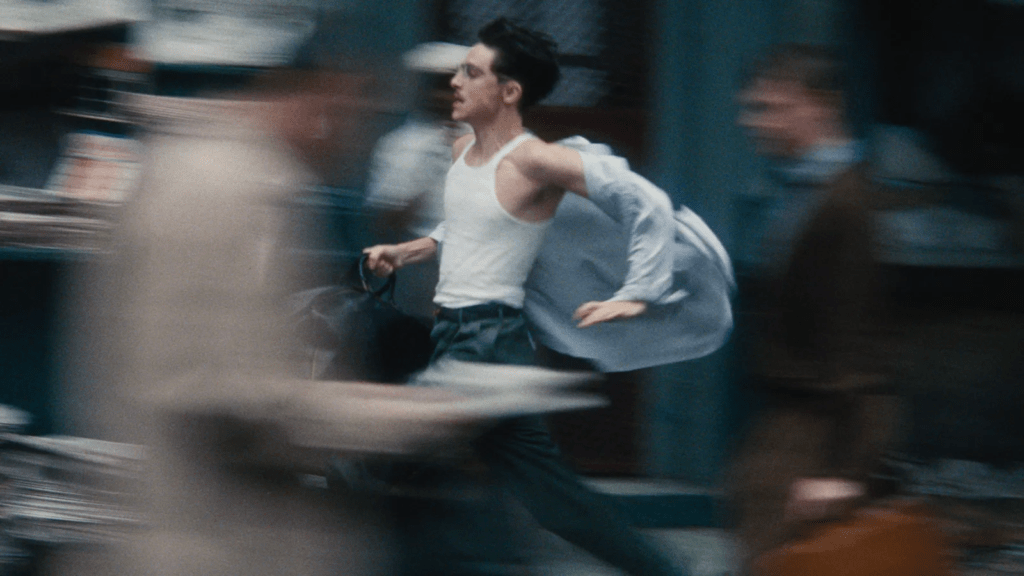
If you walk into Marty Supreme expecting a conventional rise-and-fall sports drama, the film quickly disabuses you of that idea. From its opening moments, it’s clear this story isn’t interested in tidy arcs or easy lessons.
Josh Safdie throws viewers directly into Marty Mauser’s world — loud, unstable, sweaty, and constantly in motion. The camera rarely settles, the pacing feels intentionally uneven, and the tone swings between humor, menace, and raw vulnerability. This isn’t about winning medals. It’s about hunger.
Timothée Chalamet Completely Commits to the Chaos
This may be the most physically and emotionally aggressive performance of Chalamet’s career. Gone is the quiet introspection of earlier roles. Marty Mauser is jittery, arrogant, magnetic, and deeply flawed.
Chalamet doesn’t try to make Marty likable. Instead, he makes him watchable. His body language tells half the story — the twitchy movements, the intense eye contact, the way he leans into every interaction like it’s a competition.
It’s the kind of performance that doesn’t ask for audience approval. It dares you to keep up.
Also Read : Good Boy Trailer: Haunted House Mystery Unveiled with a Dog Detective Twist
Who Is Marty Mauser, Really?
Marty isn’t just a ping-pong prodigy. He’s a hustler, a manipulator, and a dreamer who believes greatness is something you take, not earn.
Set in post-war New York, Marty exists in a world fueled by immigrant ambition and social instability. He wants recognition, respect, and dominance — and he wants it fast. Ping-pong becomes his battlefield, a place where reflexes and mind games matter more than pedigree.
But as the film unfolds, it becomes clear that Marty’s obsession isn’t really about the sport. It’s about proving his own existence.
The 1950s Setting Feels Alive, Not Nostalgic
One of the film’s greatest strengths is how it uses its time period. The 1950s here are not romanticized. This is not a postcard version of New York.
The streets feel crowded, tense, and loud. Rooms are small. Tempers are short. Opportunity exists, but only for those willing to push past others to grab it.
Safdie treats the era as an emotional pressure cooker — a place where ambition thrives because survival demands it.
Ping-Pong Has Never Looked This Intense on Film
Yes, Marty Supreme is about ping-pong — and no, it’s not played for laughs.
The matches are filmed with the urgency of street fights. The sound design amplifies every hit. The camera stays close, sometimes uncomfortably so, forcing you into Marty’s headspace.
You don’t need to understand the sport to feel the stakes. Each match becomes a psychological duel, a test of nerve as much as skill.
A Character Study, Not a Victory Lap
This film doesn’t care if Marty wins in the traditional sense. What matters is how far he’s willing to go — and what he’s willing to lose.
Marty’s relationships suffer. His ego inflates. His sense of self becomes tied entirely to performance. The film refuses to moralize these choices, which may frustrate some viewers.
But that refusal is intentional. Marty Supreme isn’t telling you what to think. It’s showing you what obsession looks like from the inside.
Josh Safdie’s Direction Is Controlled Disorder
Safdie’s style has always leaned toward chaos, but here it feels more focused. The messiness has purpose.
Scenes often end abruptly. Conversations overlap. Emotional beats don’t get underlined. The effect is disorienting — but also immersive.
You don’t watch Marty’s life unfold. You’re dragged through it.
Also Read : Bindi Irwin’s Complete Transformation: From Wildlife Princess to Global Icon
The Supporting Characters Add Texture, Not Comfort
The people orbiting Marty aren’t there to save him or fix him. They’re reflections of his choices.
Some enable his worst impulses. Others see through him but can’t pull away. Romantic connections feel volatile rather than grounding.
The supporting performances never compete with Chalamet, but they give the world dimension — reminding us that Marty’s actions ripple outward.
Why the Film Has Divided Critics and Audiences
Marty Supreme isn’t universally adored, and that’s not an accident.
Some viewers find the pacing exhausting. Others struggle to connect with a protagonist who rarely seeks redemption. The lack of a clear moral arc can feel unsatisfying if you expect closure.
But for fans of character-driven cinema, these qualities are exactly the point. The film mirrors the instability of its central character — and doesn’t apologize for it.
What Marty Supreme Is Really About
Strip away the sport, the period setting, and the noise, and Marty Supreme becomes a story about identity.
Who are you if your talent is all you have?
What happens when ambition replaces connection?
How far can obsession carry you before it empties out?
These questions linger long after the credits roll.
Timothée Chalamet’s Career Just Took a Sharp Turn
This film feels like a statement. Chalamet isn’t interested in staying comfortable or predictable.
By choosing Marty Supreme, he aligns himself with actors willing to take creative risks — even if that means alienating part of the audience.
It’s the kind of performance that won’t be universally loved, but will be studied, debated, and remembered.
Is Marty Supreme Worth Watching?
If you want something safe, probably not.
If you want a movie that feels alive, messy, uncomfortable, and bold — absolutely.
Marty Supreme doesn’t aim to please. It aims to provoke. And in a landscape crowded with formula, that alone makes it worth your time.
Also Read : Natasha Bure Marries Bradley Steven Perry: A Romantic Garden Wedding
FAQs
What is Marty Supreme about?
Marty Supreme follows a driven ping-pong hustler in 1950s New York whose obsession with winning begins to consume his identity and relationships.
Is Marty Supreme a true story?
No, the film is a fictional character study, not a biopic.
Is the movie really about ping-pong?
Ping-pong is central to the plot, but the film is more about ambition, ego, and obsession than the sport itself.
How is Timothée Chalamet’s performance?
Widely praised as one of his boldest and most physically committed performances to date.
Is Marty Supreme a typical sports movie?
Not at all. It avoids traditional sports-movie tropes and focuses on character psychology instead.
Join our WhatsApp channel for more updates and information about celebrities and entertainment.

I’m Atul Kumar, founder of Cine Storytellers and an entertainment creator with 5+ years of experience. I cover films, celebrities, music, and OTT content with a focus on accurate, ethical, and engaging storytelling. My goal is to bring readers trustworthy entertainment news that informs, inspires, and goes beyond gossip.
Discover more from Cine Storytellers
Subscribe to get the latest posts sent to your email.